Decentralized infrastructure is great… until you have to pay for it
Decentralized infrastructure often comes with fragmented payment systems.
Different networks require different tokens.
Different protocols have different transaction mechanisms.
And users or developers may need to acquire, hold and manage those tokens just to interact with the infrastructure.
For example, a dApp might need AR token to pay for decentralized storage (Arweave), while also needing DUST to interact with Midnight Network (Midnight). These are very different networks and use cases, but from the application’s perspective they’re both simply infrastructure costs that need to be paid.
That’s one of the problems we’re addressing with dStorage Pro (r/dStorage).
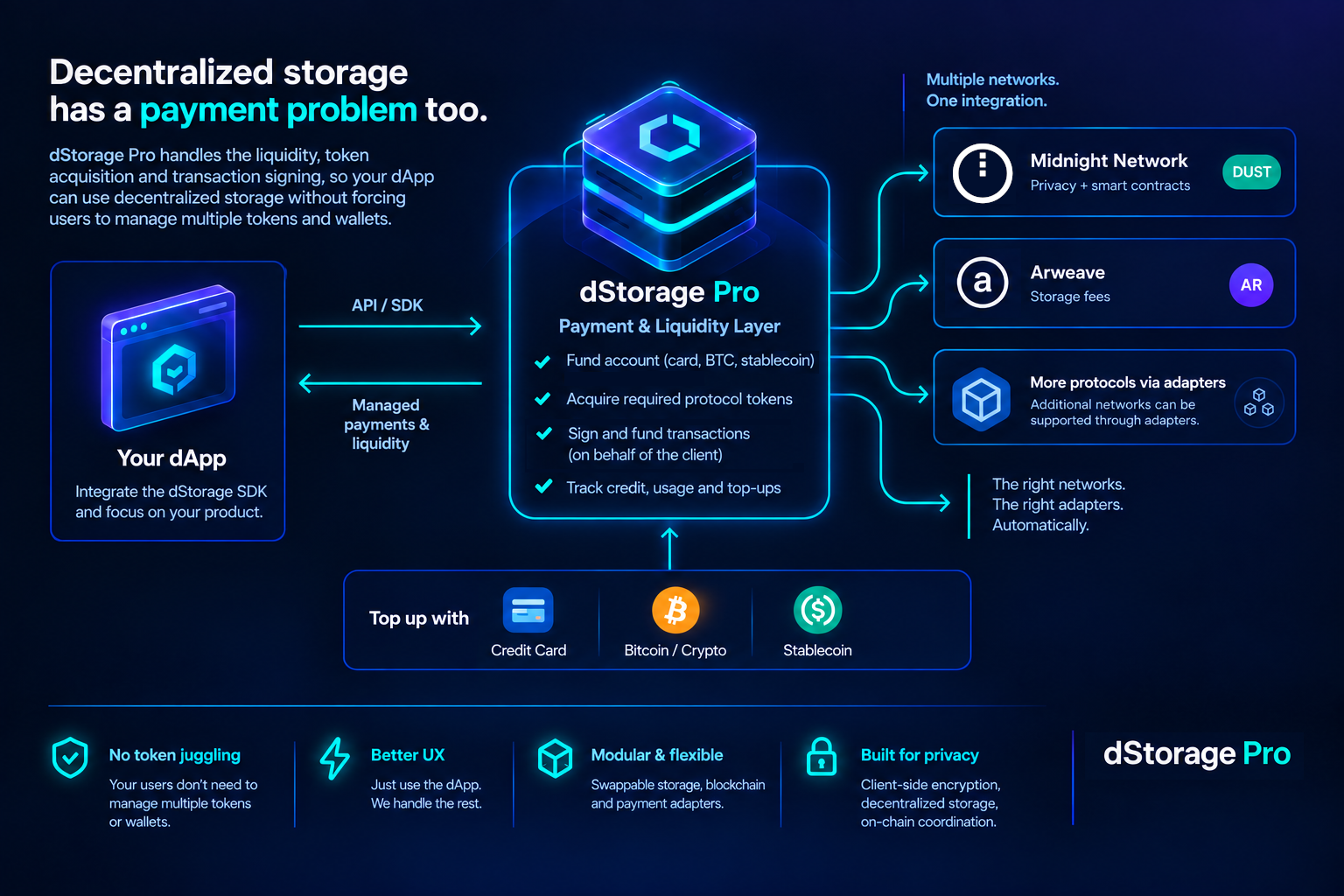
The idea is to provide a liquidity and payment layer for decentralized infrastructure, abstracting away some of the token-management complexity.
A dApp can fund its dStorage Pro account using:
- 💳 Credit card
- ₿ BTC/crypto
- 💵 Stablecoins
- …other
dStorage Pro can then handle the acquisition of the required protocol tokens and transaction signing on behalf of the application.
So instead of building separate payment infrastructure for every network, the application can interact with a common liquidity layer:
dApp → dStorage Pro → required token → decentralized network
That could mean:
AR → Arweave
or
DUST → Midnight
and potentially other decentralized networks as additional adapters are integrated.
The goal isn’t to hide the underlying protocols. It’s to make them easier for applications to use.
We’re also designing this around modular adapters, so storage, blockchain and payment infrastructure can be swapped independently rather than hard-coded into the application. (dStorage.pro docs)
We believe this is an important piece of infrastructure if decentralized applications are going to move beyond users having to understand the payment mechanics of every protocol they interact with.
The network can remain decentralized. The application doesn’t necessarily need to expose all of that complexity to the user.
I’m very curious how other Web3/decentralized projects are currently handling this:
How do you manage liquidity and protocol-specific tokens when your application interacts with multiple decentralized networks?
Originally posted on Reddit (r/web3dev).